Stepping Up Your Safeguarding Initiatives
Digital and Social Media Screening and Vetting to further enhance your safeguarding protocols for the direct benefit to the children and their parents as well as for the organisation.
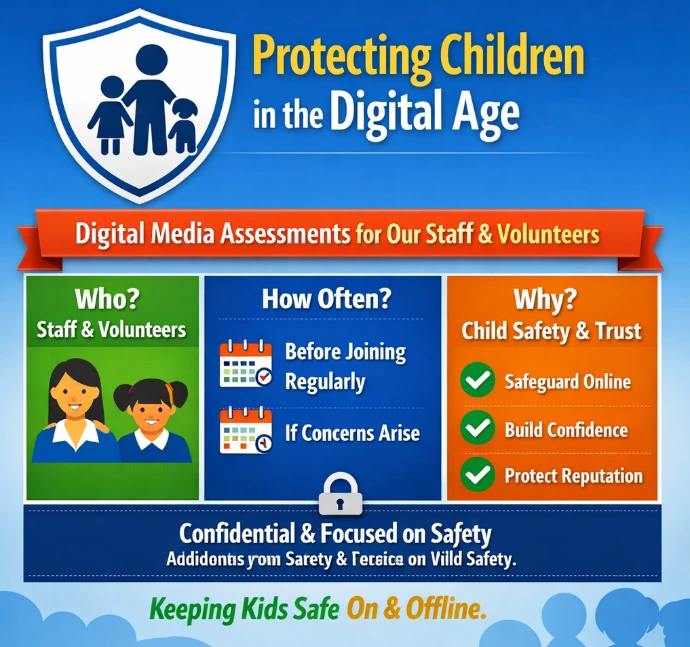
Digital Media Overview for Management of Organisations
What are the implications and issues employers and management should be aware about regarding the social and digital media behaviours of their staff and volunteers as it pertains to the safeguarding of the children in their care? What are the dangers and risks to the children as well as the institution and it's management? How can the management mitigate against this effectively? What role can digital media assessments and screening play in safeguarding the children?
This is a critical safeguarding question, and it’s correct to connect staff and volunteers’ digital behaviour with both child protection and institutional risk. Let’s break it down clearly:
Implications & Issues for Employers/Management
Risks to Children
- Boundary violations: Staff contacting children via personal accounts can blur professional lines, opening the door to grooming or exploitation.
- Privacy breaches: Posting photos, names, or details of children without parental consent exposes them to online risks and violates data protection laws.
- Indirect harm: Children may see staff engaging in discriminatory, sexualised, or risky online behaviour, normalising unsafe conduct.
- Digital footprint: Even historic posts can undermine trust if they contradict safeguarding values.
Risks to the Institution
- Reputational damage: A single inappropriate post can erode parental trust and community confidence.
- Legal liability: Breaches of child protection or privacy laws can result in lawsuits, sanctions, or loss of accreditation.
- Operational disruption: Investigations into misconduct divert resources and destabilise programs.
- Regulatory non-compliance: Failure to enforce safeguarding standards can trigger penalties from oversight bodies.
Mitigation Strategies for Management
Policies & Codes of Conduct
- Explicitly ban private online contact with children.
- Require consent for any child-related images or content.
- Define acceptable online behaviour, including personal accounts.
Training & Awareness
- Mandatory induction and refresher training on digital safeguarding.
- Use case studies to highlight risks and consequences.
- Emphasise that safeguarding applies equally online and offline.
Monitoring & Reporting
- Establish clear reporting channels for concerns about online behaviour.
- Appoint a Designated Safeguarding Officer/Leader to oversee compliance.
- Encourage peer accountability and whistleblowing protections.
Culture of Accountability
- Reinforce safeguarding as a shared responsibility.
- Promote positive, professional use of digital media.
- Apply disciplinary measures consistently when breaches occur.
Role of Digital Media Assessments & Screening
Digital media assessments can be a powerful preventive tool:
- Pre-employment screening: Reviewing candidates’ public social media for red flags (e.g., discriminatory posts, boundary-crossing behaviour).
- Ongoing monitoring: Periodic checks to ensure staff and volunteers maintain professional standards online.
- Risk profiling: Identifying patterns of behaviour that may indicate safeguarding risks.
- Education tool: Using assessments to highlight how digital footprints can affect safeguarding responsibilities.
Important caveat: Screening must respect privacy and employment law. It should be transparent, proportionate, and focused on safeguarding relevance, not personal lifestyle choices.
Digital and Social Media Screening should NEVER be used to “catch out” staff or volunteers. It should be used to help everybody to ensure their social media behaviour is consistent with the values of the organisation and of no risk to the welfare and integrity of the organisation.
Summary Table
|
Risk Area |
Impact on Children |
Impact on Institution |
Mitigation Action |
|
Inappropriate contact |
Grooming, exploitation |
Legal liability, reputational harm |
Ban private online contact |
|
Privacy breaches |
Loss of safety, exposure |
Regulatory penalties |
Consent-based photo policy |
|
Harmful content |
Emotional distress |
Trust erosion |
Training + monitoring |
|
Poor role modelling |
Normalization of unsafe behaviour |
Community backlash |
Clear conduct guidelines |
Practical Steps for Management
- Draft a Social Media Safeguarding Policy with clear do’s and don’ts. (Please contact us for examples.)
- Integrate digital behaviour checks into recruitment and volunteer onboarding. (Contact us for examples.)
- Provide annual training on digital safeguarding, including emerging platforms. (Contact us should you need us to come and conduct the training.)
- Establish a review mechanism for incidents, ensuring lessons are learned and policies updated.
Bottom line: Children’s safety depends on staff and volunteers maintaining professional boundaries online. Institutions must combine policy, training, monitoring, and digital screening to protect both children and their own integrity. Let us help you to achieve your quest to provide the safest spaces for our vulnerable citizens.
HOW CHILD PROTECTION SCREENING WILL HELP YOU :
- Contact us with the following information : the contact details of your designated leader/manager who will manage the process as well as the name of your organisation/school/club/church/etc. and approximately how many staff members and volunteers will need to be screened. Let us also know of any other questions you may have in preparing yourselves and the staff/volunteers for Digital and Social Media Screening.
- We will send you a pro-forma invoice for confirmation and acceptance.
- We will send you all the documentation required as well as the process that will be followed.
- We will have the applications processed and send you the resultant assessment reports for each of the candidates.